
Geogames Symposium 2025 keynote speakers

Program-, Scientific- and Organizing Committees

Program Committee

Alenka Poplin, Iowa State University, USA
Ítalo Sousa de Sena, University College Dublin, Ireland
Arghavan Akbarieh, Eindhoven University of Technology, The Netherlands
Ariane Magda Borges, Federal University of Goiás, Brazil

Scientific Committee

Ola Ahlqvist, The Ohio State University, USA
Arghavan Akbarieh, Eindhoven University of Technology, The Netherlands
Mónica Alcindor, Portucalense University, Portugal
Bruno Amaral de Andrade, Federal University of Bahia, Brazil
Luiz Adolfo de Paiva Andrade, State University of Bahia, Brazil
Michely Gomes Avelar, Federal Institute of Goiás, Brazil
Jeremy Best, Iowa State University, USA
Ariane Magda Borges, Federal University of Goiás, Brazil
Luciana Bragança, Federal University of Minas Gerais, Brazil
Anson Call, Iowa State University, USA
Raul Isaías Campos, Federal University of Goiás, Brazil
Marta Brković Dodig, Singidunum University, Serbia
Stefan Göbel, Darmstadt University of Technology, Germany
Qi Han, Eindhoven University of Technology, The Netherlands
Jared Hansen, Iowa State University, USA
Casper Harteveld, Northeastern University, USA
Xu Liu, Atlantic Technological University, Ireland
Yanhua Lu, Iowa State University, USA
Kotaro Izuka, University of Hyogo, Japan
Avin Khalilollahi, Nemex, The Netherlands
Xu Liu, Atlantic Technology University, Ireland
Charles Madeira, Federal University of Rio Grande do Norte, Brazil
Deepak Marhatta Tribhuvan University, Nepal
Cameron MacKenzie, Iowa State University, USA
Konstantinos Papangelis, Rochester Institute of Technology, USA
Celen Pasalar, North Carolina State University, USA
Josh Perry, East Carolina University, USA
Alenka Poplin, Iowa State University, USA
Claudia Lucia Rojas, Universidad del Norte, Colombia
Christoph Schlieder, University of Bamberg, Germany
David Schwartz, Rochester Institute of Technology, USA
Ítalo Sousa de Sena, University College Dublin, Ireland
Yusuf Sermet, Tulane University, USA
Micael Sousa, Center for Advanced Preparedness and Threat Response
Simulation, USA
Todor Stojanovski, Royal Institute of Technology, Sweden
Brian Tomaszewski, Rochester Institute of Technology, USA
Ziyu Tong, Nanjing University, China
Eszter Tóth, University of applied sciences Darmstadt, Germany
Jeffrey Wheatley, Iowa State University, USA
Aaron Yang, Iowa State University, USA
Moira Zellner, Northeastern University, USA

Local Organizing Committee

Ariane Magda Borges, Federal University of Goiás, Brazil
Michely Gomes Avelar, Federal Institute of Goiás, Brazil
Raul Isaías Campos, Federal University of Goiás, Brazil
Gustavo Hilário de Lira Christino, Goiás Game Developers Association (GameGO), Brazil
Michelle Santos Costa, Goiás Game Developers Association (GameGO), Brazil
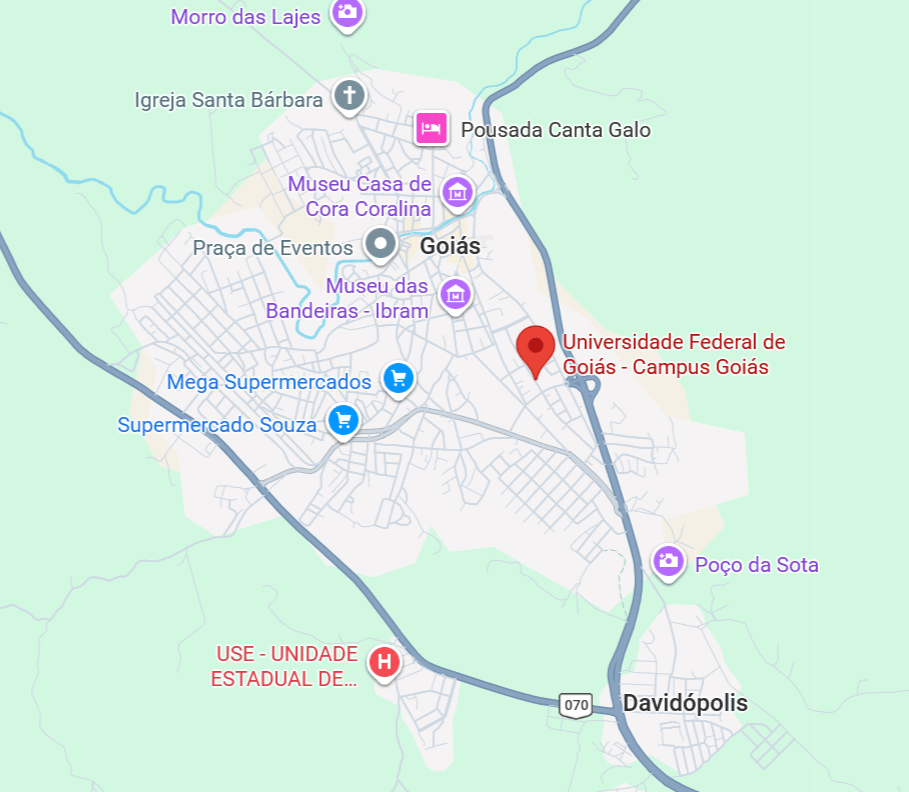
Symposium Location

The 4th Geogames Symposium will be organized at the Federal University of Goiás, Goiás town, Goiás in Brazil.

More specifically: at the UFG Special Academic Unit of Social Sciences, Universidade Federal de Goiás – Campus Goiás

Submission deadlines

Here are important deadlines – please, mark your calendars:

  • First submission for peer-review: December 20 (00:00 UTC)
  • Reviews completed: January 29
  • Acceptance letters sent to the authors: February 15
  • Upload the final contributions: March 19

2027 Geogames Symposium

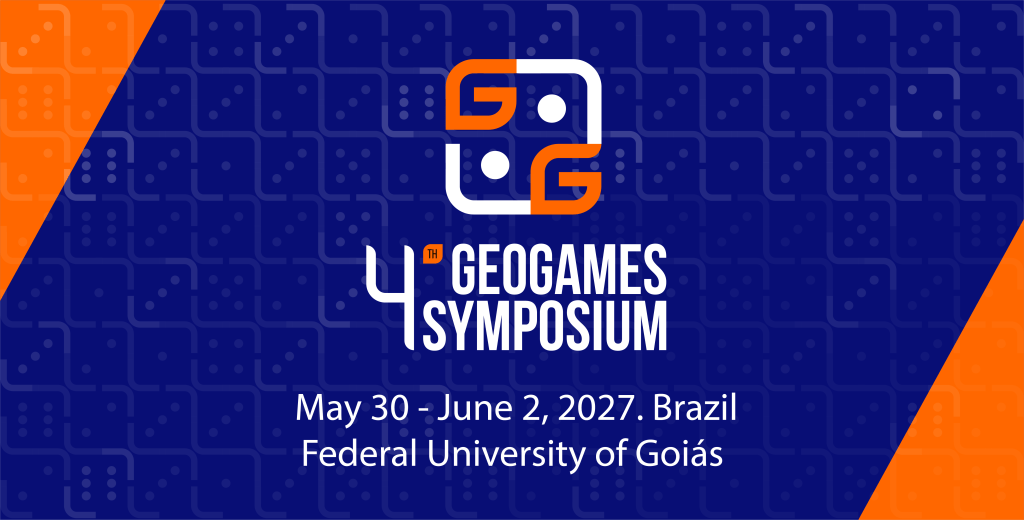
The 4th Geogames Symposium (4GGS) brings together researchers, developers, designers, practitioners, and game enthusiasts to exchange ideas and advance the growing field of geogames. It offers a platform for the exploration of how analogue, digital, and hybrid geogames can connect people, places, environments, and cultures,and inspire new ways of understanding and shaping our world.

This year, 4GGS places a special focus on geogames for cultural heritage and place. How can geogames help experience historic places differently? How can games bring stories, memories, traditions, architecture, and cultural landscapes to life? We invite contributions exploring how geogames can help discover, preserve, interpret, and reimagine heritage while creating meaningful connections between the past, present, and future. We welcome theoretical, methodological, experimental, and applied contributions related to geogames, game design, and playful approaches to place.

What are Geogames? 4GGS builds on the definition proposed by Poplin (2025): “Geogames are digital, analogue, or hybrid games that center on Gaia as Earth’s interconnected system of the physical environment, living organisms and its non-physical elements. They create playful experiences grounded in the use of real-world geographic data, locational knowledge, and spatial reasoning.” The broader definition
emphasizes geogames as playful experiences that foster systems thinking, problem-solving, environmental awareness, and the resilience and well-being of Earth’s systems.

Let’s explore how geogames can:

  • Bring cultural and architectural heritage to life
  • Connect people with places, histories, stories, and identities
  • Preserve and reinterpret tangible and intangible heritage
  • Strengthen community engagement and placemaking
  • Inspire playful responses to local and global challenges
  • Encourage environmental awareness, responsibility, and care
  • Create more resilient, sustainable, and regenerative futures

We invite you to join us at 4GGS!

Topics may include cultural heritage, architecture, historic preservation, urban planning and design, placemaking, community engagement, history, geography, geospatial science, digital twins, climate resilience, environmental challenges, psychology, anthropology, health and well-being, and more. We especially welcome work that crosses disciplinary boundaries and explores new relationships between
games, people, place, and heritage.

Let’s play with the past, experience the present, and co-create the future through geogames.

Key research topics include and are not limited to:

  • Geogames, Cultural Heritage, and Place
    Explore how geogames can bring cultural and architectural heritage, histories, memories, traditions, and places to life through playful experiences.
  • Co-Creation with Geogames
    Explore how geogames can engage communities in participation, co-creation, citizen science, and collaborative planning while enabling players to imagine, visualize, and explore more resilient, inclusive, and sustainable futures.
  • Geogames Across Application Areas
    Share geogame applications in education, planning, architecture, environment, health, disaster management, geography, cybersecurity, religion, and other fields.
  • Geogame Design, Technology, and Evaluation
    Present approaches to geogame design, prototyping, playtesting, and evaluation, including AI, AR/VR/MR, digital twins, geospatial technologies, and other emerging technologies.
  • Theory of Geogames
    Contribute to the foundation of geogames by presenting theoretical foundations for geogames.

SUBMISSION TYPES

All submissions should include the title, names of the author(s), their affiliation(s), and their emails. INDICATE one of the following submission types:

  • Short paper demonstrates most recent research in the form of a short scientific paper. It should contain between 750-1000 words. Please include a problem statement, research focus, research methodology, results and conclusions.
  • Workshop is in-person run workshop on a selected topic of geogames. It can last 2 – 3 hours. The submission should describe the goals of the workshop in around 300 words.
  • Game demonstration is in-person showcase of the game or games developed by the authors. These games can already be a final product or in the phase of testing as a testable prototype. The authors bring their games and showcase them to the participants. Descriptions of these games should be around 300 words long.
  • Student forum is in-person gathering of students showing and demonstrating their work related to geogames. The descriptions should be around 500 words long and can include created geogames or their prototypes, graduate or PhD thesis work related to games, class work or research in progress.
  • Panel is a discussion forum on a specific topic of geogames which can include theoretical approaches, revisiting definitions, exciting novel ideas. Descriptions should be around 500 words long.

Every accepted contribution will receive an individual DOI. They will be openly accessible and will be officially published via the Iowa State University Digital Press. The proceedings will also be available in PDF format via the same publisher.

Additionally, please choose between IN-PERSON or ONLINE presentation mode on EasyChair platform.

SUBMISSION DEADLINES

  • First submission for peer-review: December 20 (00:00 UTC)
  • Reviews completed: January 29
  • Acceptance letters sent to the authors: February 15
  • Upload the final contributions: March 19

REGISTRATION FEES

Indicate how would you like to participate: online or in person

  • Students: $40
  • Early bird by March 16: $120
  • Regular registration fee after March 15: $160

Let’s explore together how geogames can promote environmental awareness, foster community engagement and cohesion, and offer creative solutions to local and global urban challenges!

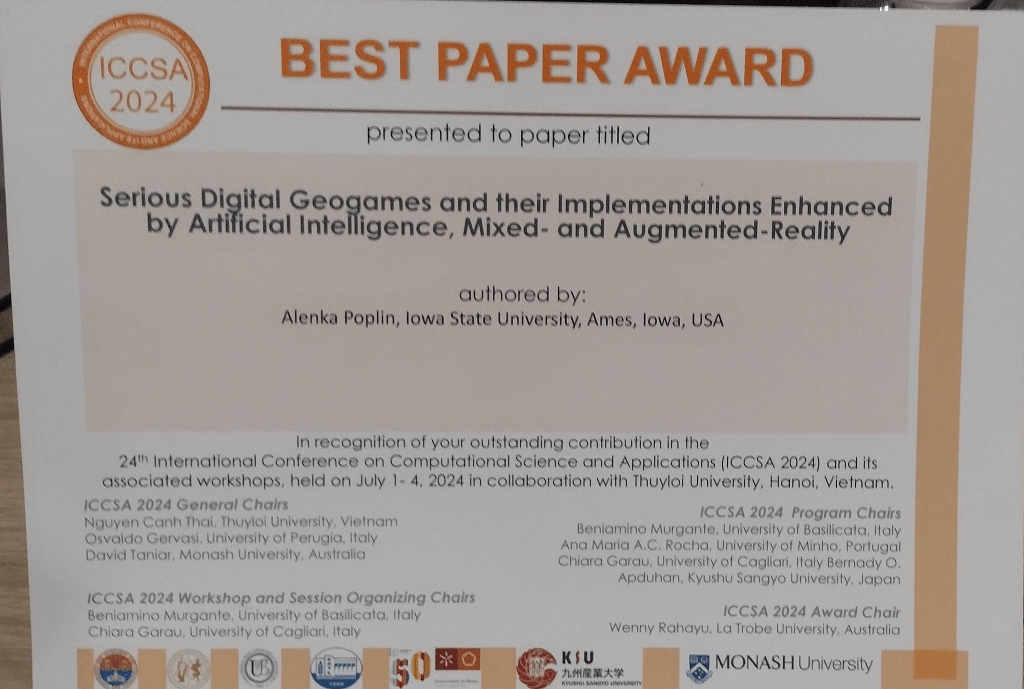
Best Paper Award

New article: Serious Digital Geogames and Their Implementations Enhanced by Artificial Intelligence, Mixed- and Augmented-Reality by Alenka Poplin.

This paper received the best paper award at The 24th International Conference on Computational Science and Its Applications in Hanoi, Vietnam #https://iccsa.org/. Congratulations Geogames Lab team!!!

Iowa State gets new Game Design Major

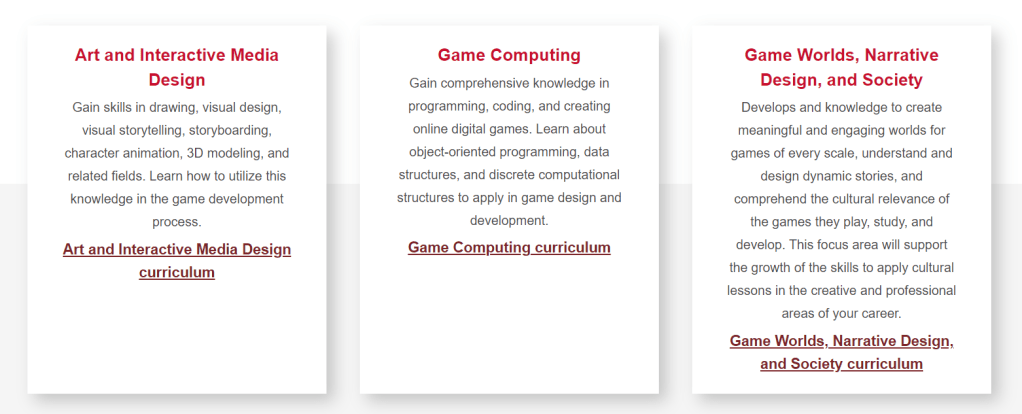
The Board of Regions approved the proposal for a new undergraduate Game Design Major at Iowa State University on September 19 at 9:45 am. Students will be able to officially enroll in the Fall 2025 and choose among one of the following specialized focused areas: art and interactive media design; game computing; and game worlds, narrative design, and society.

More can be found on the website:

Bachelor of Science in Game Design

We just finished our e-footprints energy game

Congratulations to the team!

09_11_Energy Game_Activity Diagram

See our publications:

Poplin, A. 2020. Big Data and Occupants Behavior in a Built Environment: Introducing a Game-Based Data Collection Method, Journal of Urban Planning and Development (JUPD), Special Issue on Data Science & the Built Environment. Volume 146, Issue 2 (June 2020), published online on March 19, 2020, American Society of Civil Engineers, DOI: 10.1061/(ASCE)UP.1943-5444.0000552.

Poplin, A. 2020. Energy Geogame ‘e-footprints’. Prototype Designed to Collect Data about Human Behavior in Built Environments, In: Brković Dodig and Groat (eds) Rutledge Companion to Games in Architecture and Urban Planning: Tools for Design, Teaching and Research, p. 163 – 174, Taylor & Francis / Routledge, New York.